CRM Is More Than Email Marketing

Understanding the bigger picture of customer relationship management, and why it matters to business growth.
I've spent a significant part of my career working in Customer Relationship Management, or CRM. And over the years, I've noticed something interesting.
When I tell people I work in CRM, I often get a response along the lines of, "Oh, so you do email marketing?"
Well, yes. But also, so much more.
Even among experienced marketing professionals, I've found there's sometimes a misunderstanding about what CRM actually encompasses.
And I understand why. Email marketing is one of the most visible components of CRM. In many organizations, the email team eventually grows into the CRM team.
That's actually pretty close to my own professional journey.
I Was an Email Marketer, Too
Earlier in my career, I was an email marketer in the truest sense of the term. Email was my channel, and I was responsible for making it perform.
That meant understanding my audience, developing segments, creating campaigns, coordinating creative and messaging, managing deployment schedules, and measuring results.
There were plenty of metrics to obsess over: deliverability, clicks, conversion rates, revenue per email sent, unsubscribe rates, and more.
And then there's everything that happens behind the scenes.
Email marketers have to understand sender reputation, data quality, authentication, testing, rendering across devices, audience suppression, and the regulatory requirements governing commercial messaging.
They're balancing business objectives against the risk of fatiguing their audience. They're figuring out when to send, what to say, whom to target, and perhaps most importantly, when not to send.
It's a remarkably deep discipline, and I've worked with some exceptional email marketers over the years. Some of my favorite people in marketing have built their careers mastering this channel.
I don't want to diminish email in the slightest.
Email marketing is an important and sophisticated discipline. But it represents just one part of a much larger practice: Customer Relationship Management.
So, What Exactly Is CRM?
At its core, Customer Relationship Management is about understanding customers, building meaningful relationships with them, and creating value throughout those relationships.
In its broadest definition, CRM encompasses marketing, sales, and customer service. For this discussion, I'm focusing primarily on the marketing side of CRM, where I've spent most of my career.
I think about CRM as the connective tissue between the customer, the business, and the many interactions that take place between them.
It starts with understanding who your customers are. Not just their email addresses, but what they buy, how they shop, what they're interested in, how they've engaged with your brand, and where they are in their relationship with your business.
It also means recognizing that customers don't experience brands in departmental silos.
A customer might discover your brand through an advertisement, browse your website, call a salesperson, visit a physical store, make a purchase, and eventually contact customer service.
To the customer, those aren't six different departments or systems.
They're one relationship with your brand.
And that's precisely where CRM becomes so important.
A Real-World Example: Guitar Center
One of the clearest examples of this comes from my most recent role, leading CRM at Guitar Center.
Guitar Center is the largest musical instrument retailer in the United States, with more than 300 retail locations and a brand that's been part of the music industry for decades.
The company has invested significantly in e-commerce, digital marketing, and highly trained sales teams working across multiple contact centers. Digital has been a critical growth driver.
But for many musicians, Guitar Center is still first and foremost a place you go.
It's something of a Disneyland for musicians. You walk through the doors, see walls of guitars, hear someone trying out an amplifier, and have the opportunity to put your hands on an instrument before making a decision.
That physical experience is central to the customer relationship.
Now, Guitar Center also has a substantial email marketing program, with strong engagement and deliverability, low unsubscribe rates, and customers who genuinely enjoy engaging with its content.
But here's where things get interesting.
Imagine a customer receiving an email on Tuesday featuring a new guitar. They open it, browse the products, maybe visit the website, and then go about their week.
On Saturday, that same customer walks into their local Guitar Center, picks up a few instruments, talks with a knowledgeable salesperson, and ultimately makes a purchase.
If we're evaluating the email program strictly through clicks, online conversions, and directly attributed revenue, we may be missing an important part of that customer's journey.
Did the email contribute to the eventual purchase? Possibly. But we shouldn't automatically assume it did simply because the customer received it.
What we can do is build a more complete understanding of that customer and their interactions with the business.
At Guitar Center, that meant bringing together store-level sales data from more than 300 locations, online behavioral data, and interactions with our call centers.
Customer records were matched and unified through daily identity resolution processes, helping us build a more complete understanding of customers across channels.
That information supported more informed decisions about whom to engage, which channels to activate, and what experiences or communications might be most useful at a particular moment in the customer's musical journey.
Think about what that means.
A customer who just purchased an expensive guitar in-store might be better served by helpful ownership tips, information about maintenance, or relevant accessories than another promotional message asking them to buy that same guitar online.
The email marketer can optimize the effectiveness of the email itself.
CRM helps us understand whether that email is even the right interaction for that customer in the first place.
That's the bigger picture. And it's why understanding the full customer relationship matters so much.
The Seven Building Blocks of CRM
Over the years, I've come to think about marketing-led CRM as a combination of seven interconnected disciplines.
Depending on the organization, the CRM team might directly own some of these functions while collaborating with dedicated teams responsible for others.
The important distinction is that CRM helps connect these capabilities around a shared customer strategy.
1. New Lead and Customer Acquisition
Every relationship has a beginning.
While acquisition teams often own paid media and lead generation, CRM plays a critical role in recognizing, nurturing, and converting the people those investments bring into the business.
Generating a lead is only the beginning. Maximizing the value of that relationship is where CRM comes into play.
2. Customer Data Strategy and Centralization
Businesses often know more about their customers than they realize. Unfortunately, that information frequently lives in disconnected systems.
CRM partners with data and technology teams to bring relevant information together into a unified customer profile, sometimes called a golden record or 360-degree view of the customer.
The goal isn't to collect every possible data point. It's to responsibly connect the information that matters so the business can better understand the people it serves.
3. Audience Segmentation
Not every customer has the same interests, needs, or relationship with your brand.
Segmentation helps recognize those differences, whether it's distinguishing first-time buyers from loyal customers, understanding product interests, or identifying customers who may be ready for another purchase.
The better we understand our audiences, the more relevant our interactions can become.
4. Customer Behavior and Tracking
What customers tell us is valuable. What they do can be equally revealing.
CRM looks at behavior across the customer experience, including website activity, purchase history, sales interactions, and customer service engagement.
Importantly, this isn't limited to digital channels. In businesses with physical stores and contact centers, offline behavior can be every bit as important.
5. Marketing Automation
As customer relationships become more complex, delivering relevant experiences at scale requires automation.
Think welcome programs, post-purchase education, personalized recommendations, service reminders, and re-engagement campaigns.
Good automation isn't about sending more messages with less effort. It's about making each interaction more timely, relevant, and useful.
6. Channel Ownership and Execution
Here's where email marketing comes back into the picture.
CRM programs frequently manage channels such as email, SMS, direct mail, and mobile push notifications while coordinating with teams responsible for paid media, website experiences, retail stores, and other touchpoints.
The goal is to make those channels work together rather than operate independently.
7. Lifecycle Marketing and Customer Retention
Perhaps the most important question CRM can help answer is:
How do we turn a one-time transaction into a valuable, lasting customer relationship?
Understanding the customer lifecycle means recognizing that someone discovering your business for the first time has very different needs from someone who has been shopping with you for ten years.
Lifecycle marketing helps deliver appropriate experiences at each stage, ultimately improving retention, purchase frequency, and customer lifetime value (CLV).
And the customer objective matters just as much as the business objective: consistently give people reasons to choose your brand again.
Email Marketing vs. CRM: What's the Difference?
One of the simplest ways to illustrate the distinction is to compare the typical focus of each discipline.
| Dimension | Email Marketing | CRM |
|---|---|---|
| Primary focus | Email channel performance | The overall customer relationship |
| Customer data | Subscribers and email engagement | Unified customer data across touchpoints |
| Audience | Email-reachable customers | Prospects, new, active, and lapsed customers |
| Channels | Multiple channels, online and offline | |
| Key goals | Engagement, traffic, conversions, email revenue | Conversion, retention, customer growth, lifetime value |
| Success measures | Clicks, deliverability, revenue per send | Repeat purchases, CLV, incremental revenue and profit |
These aren't rigid boundaries. Great email marketers often work deeply in segmentation, automation, customer data, and lifecycle strategy.
The difference is primarily one of scope and accountability.
Email marketing asks how we can make a communication channel more effective.
CRM asks how we can make the entire customer relationship more effective.
The CRM Growth Flywheel
One of my favorite ways to think about CRM is as a growth flywheel.
Businesses spend considerable resources acquiring new customers. Depending on the business, that investment might include advertising, promotions, sales teams, partnerships, content, and other forms of lead generation.
But what happens after a customer enters the ecosystem?
That's where CRM has an opportunity to create tremendous value.
I visualize the process as a continuous cycle:
Acquire → Understand → Engage → Convert → Retain → Grow → Reinvest
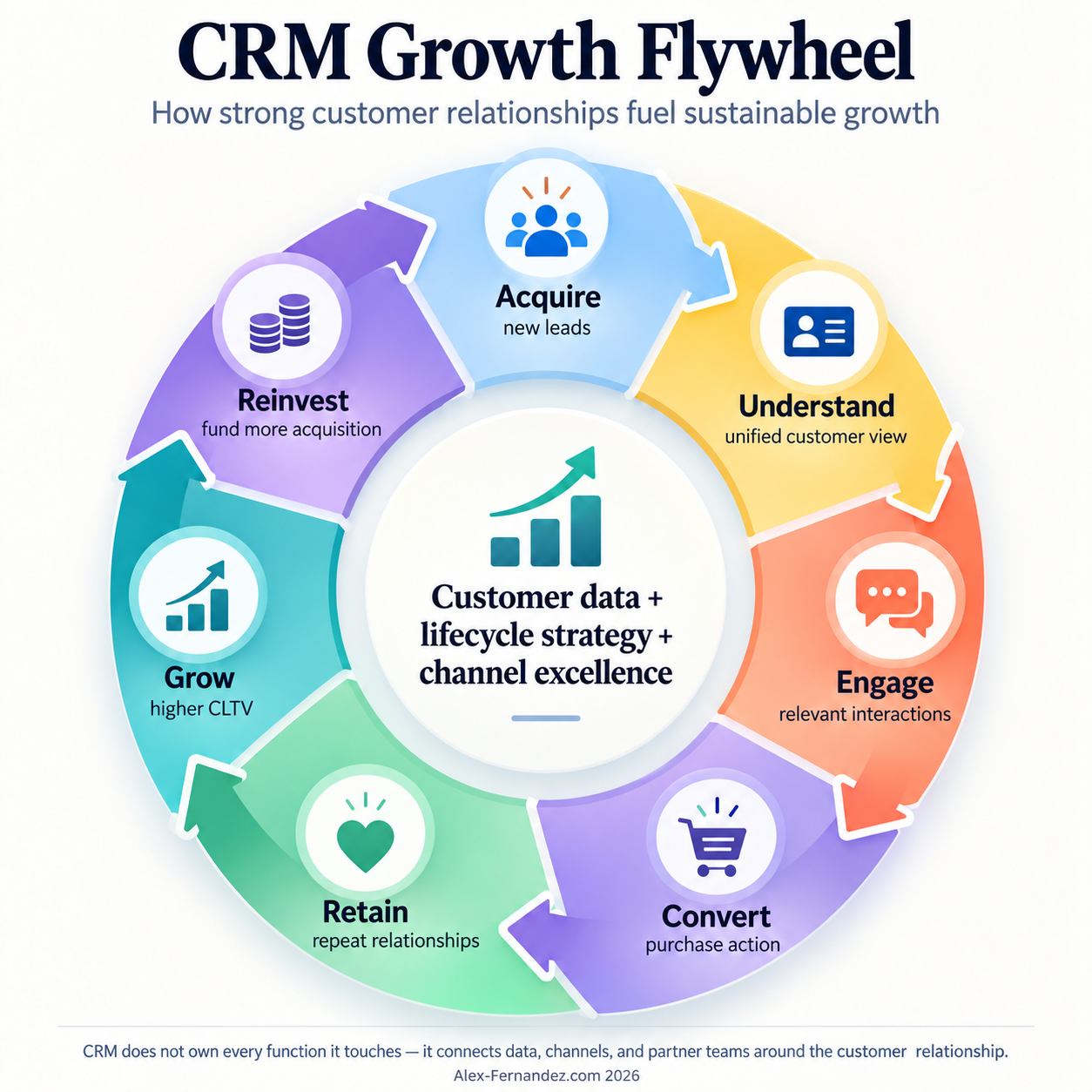
First, the business acquires leads and customers.
Through customer data, identity resolution, segmentation, and behavioral understanding, we learn more about them.
Relevant communications, personalized experiences, and effective lifecycle programs help turn those relationships into purchases, repeat purchases, and long-term loyalty.
As retention and customer lifetime value improve, the business has the opportunity to generate incremental revenue and profit.
That profit can then be reinvested into acquiring more customers, feeding the flywheel and continuing the cycle.
Of course, not all revenue growth is necessarily profitable or incremental. A promotion that simply discounts something a customer was already going to buy might increase attributed marketing revenue without creating much additional business value.
The real opportunity is to improve the economics of the entire customer relationship.
In a mature CRM program, the objective isn't just to generate more sales today. It's to make customer relationships more valuable over time, for both the customer and the business.
Where CRM Meets Marketing Technology
There's another dimension to all of this that deserves attention: the technology required to make it happen.
Centralizing customer data, recognizing identities, tracking behaviors, coordinating channels, and orchestrating personalized experiences all require sophisticated technical capabilities.
This is where CRM and marketing technology, or MarTech, become deeply intertwined.
CRM leadership helps define the customer strategy, the experiences the business wants to deliver, and the outcomes it hopes to achieve.
MarTech leadership helps translate that vision into the architecture, integrations, platforms, and capabilities necessary to make it happen.
In my experience, the head of CRM and the head of MarTech should be among each other's closest partners.
But CRM doesn't own everything it touches.
Data engineering, analytics, e-commerce, paid media, retail operations, sales, and customer service all have their own functional leaders, objectives, and responsibilities.
CRM's role is to help connect those capabilities around the customer relationship, ensuring that the business can act on a more complete understanding of the people it serves.
This is one of the things I've come to appreciate most as my career has evolved.
CRM is as much about connecting people and business functions as it is about connecting customer data and technology.
Bringing It All Back to the Customer
Looking back at my progression from email marketing into broader CRM leadership, the biggest change wasn't simply learning new tools or taking responsibility for additional channels.
It was learning to look at the business through the lens of the entire customer relationship.
Email marketing remains an incredibly important part of that work. In many organizations, it's one of the most powerful ways to communicate directly with customers and drive measurable results.
But effective CRM goes beyond the inbox.
It's the strategy, data, technology, people, and processes that help a business understand its customers and build relationships worth maintaining.
And when businesses truly understand their customers, growth and success tend to follow.
Coming Up Next: The Importance of Customer Identity
There's one foundational challenge underneath nearly everything I've discussed here.
How do you know who your customer actually is?
Consider someone who browses your website on their phone, calls your sales team the next day, and makes a purchase in a physical store that weekend.
Can your business recognize those interactions as belonging to the same person?
That's the challenge of customer identity resolution, and it's a fascinating intersection of customer experience, data strategy, and marketing technology.
In a future article, I'll explore why identity resolution is such an important foundation for modern CRM, some of the challenges businesses face, and lessons I've learned from implementing these capabilities.
Because before you can deliver a truly connected customer experience, you have to be able to recognize the customer you're trying to serve.